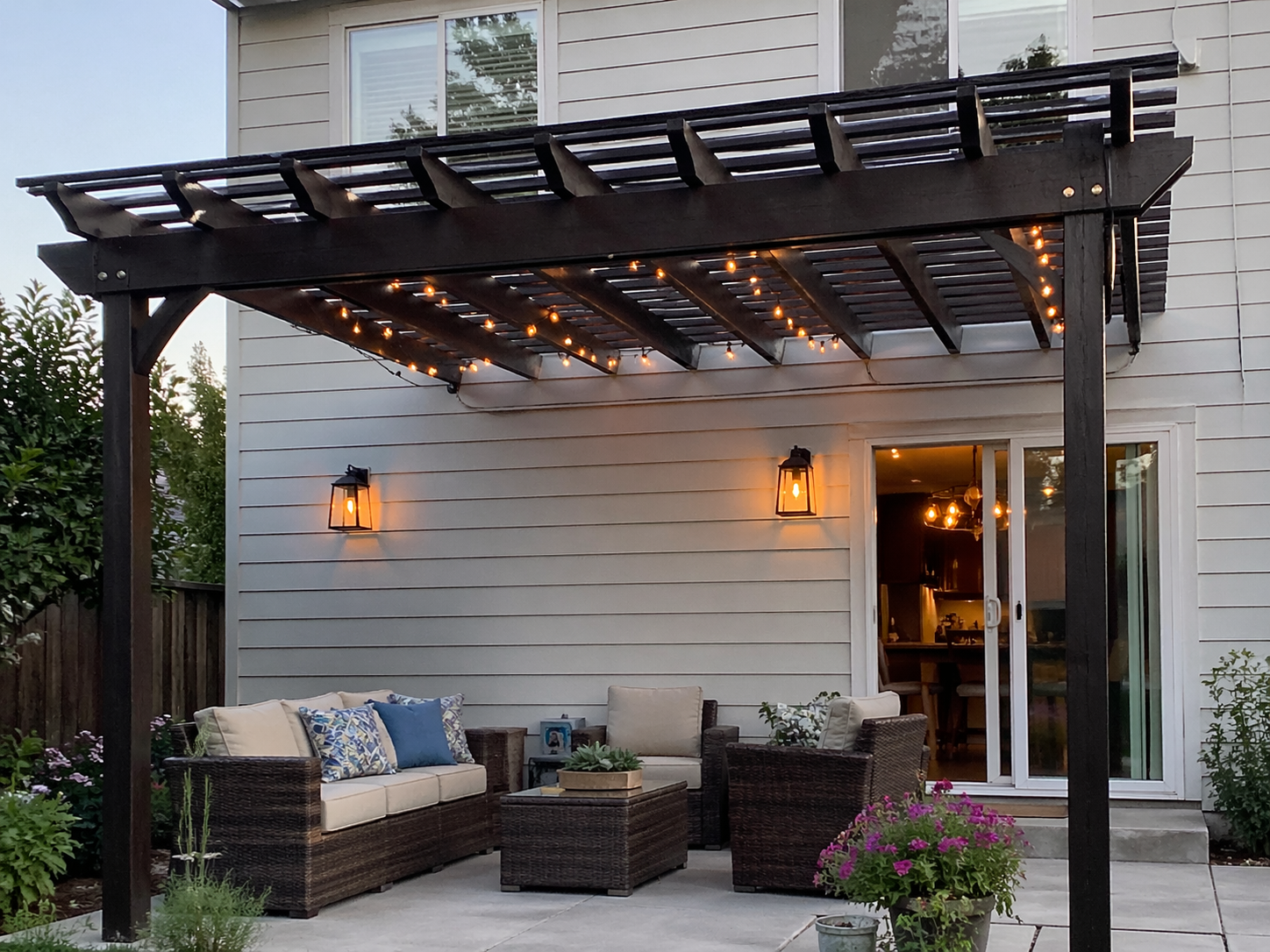
Is an attached or freestanding pergola cheaper? Attached pergolas typically cost $500 to $1,500 less than a freestanding pergola of the same size because they use only 2 posts instead of 4 and require less concrete, lumber, and labor. The savings can disappear if your home needs reinforcement, flashing, or permit-heavy roof work. For most Tulsa homeowners, attached wins on budget when the house is structurally ready for it.
Is an attached or freestanding pergola cheaper? In most cases, attached pergolas cost $500 to $1,500 less than a freestanding pergola of the same size because they use the house for support and need fewer posts and footings. That said, the savings can shrink fast if your home needs reinforcement, flashing, or unusual roof-line integration. Here is exactly what each option costs to install in Tulsa in 2026, what drives the price difference, and which one makes more sense for your backyard.
Arrow Outdoor Living is known around Tulsa as The Tulsa Pergola Builder, and we have been designing and installing both attached and freestanding pergolas across the metro since 2021. With 41 five-star Google reviews from homeowners who wanted straight answers on pricing, this guide reflects what we quote and build every week. No inflated numbers, no fluff.
What’s the Cost Difference Between Attached and Freestanding Pergolas?
The cost difference between attached and freestanding pergolas typically runs $500 to $1,500, or roughly 10 to 15% of the total project cost. Attached wins on budget in the vast majority of Tulsa installations because it uses the existing home as structural support, which means fewer posts, less concrete, less lumber, and faster labor.
Why the gap exists:
- 2 posts vs. 4 posts: attached pergolas use the house to carry one side. Saves on materials and footings
- 2 footings vs. 4 footings: less concrete poured below Tulsa’s 12-inch frost line
- Faster install: typically 1 to 3 days for attached vs. 2 to 4 days for freestanding
- Less support framing: no need to buy and mount a fourth side of rafters and beams
When the savings disappear: if attaching the pergola requires structural reinforcement, complex flashing, or roof-line integration, attached can match or exceed freestanding costs. We walk every project carefully before quoting to make sure the savings are real.
How Much Does an Attached Pergola Cost in Tulsa?
An attached pergola in Tulsa generally costs $5,500 to $23,500+ installed, depending on size and material. Here are price ranges by size for attached cedar builds:
- 10×10 attached cedar pergola: $5,500 to $10,500 installed
- 12×12 attached cedar pergola: $6,500 to $11,000 installed
- 12×16 attached cedar pergola: $11,000 to $18,500 installed
- 14×20 attached cedar pergola: $14,000 to $23,500 installed
What’s included: two posts with concrete footings below the frost line, ledger board attachment to the home, rafters and crossbeams, hardware, flashing, permit fees, and labor. Arrow builds every pergola with full structural engineering for Oklahoma wind loads, proper footings, and Wood Defender stain for long-term protection.
For full pricing on every pergola type, see our 2026 pergola cost guide.
How Much Does It Cost to Build a Pergola Attached to a House?
Building a pergola attached to a house costs less in raw structure but adds a few attachment-specific expenses. Here is what you are paying for on the attachment side:
- Ledger board installation: $300 to $800 in labor depending on wall condition
- Flashing to prevent water intrusion: $150 to $400
- Roof-line integration if the pergola ties into an existing roof: $500 to $2,000 extra
- Structural inspection if attaching to aging siding or stucco: $200 to $500
- Permit fees: $75 to $200 in Tulsa (nearly always required for attached builds)
How attached pergolas save money:
- 2 posts instead of 4 saves $300 to $800 in materials
- 2 footings instead of 4 saves $200 to $500 in concrete work
- Faster install (1 to 3 days vs. 2 to 4 days) saves $200 to $600 in labor
- No need to buy a fourth side of rafters and support framing
The net result is still $500 to $1,500 in savings for most Tulsa projects, but only when the attachment is straightforward. A home with intact siding, sound framing, and a clean wall for the ledger board is the ideal scenario.
How Much Does a Freestanding Pergola Cost in Tulsa?
A freestanding pergola in Tulsa generally costs $6,000 to $25,000+ installed, matching Arrow’s published service-page pricing. Here are size-based ranges:
- 10×10 freestanding cedar pergola: $6,000 to $12,000 installed
- 12×12 freestanding cedar pergola: $7,500 to $12,500 installed
- 12×16 freestanding cedar pergola: $12,000 to $20,000 installed
- 14×20 freestanding cedar pergola: $15,500 to $25,000 installed
What’s included: four posts with concrete footings below Tulsa’s 12-inch frost line, rafters and crossbeams, hardware, permit fees, and labor. Large custom freestanding builds with polycarbonate roofs, fans, or lighting can push $25,000 and up.
Why freestanding sometimes costs more than the base difference suggests:
- Deeper site prep if the yard is not level adds $200 to $500 for grading
- Longer material carries from truck to install site add labor time
- Full support system needed with more structural load on each post
- Hardware like heavy post anchors and wind bracing costs more than attached hardware
Is an Attached or Freestanding Pergola Cheaper? Real Tulsa Examples
Yes, an attached pergola is cheaper than a freestanding one of the same size in almost every Tulsa installation. Here are two real-world examples that show the gap in practice:
Example 1: 12×14 cedar pergola in Bixby
- Attached version: around $8,500 installed
- Freestanding version: around $9,800 installed
- Difference: about $1,300, or 15% more for freestanding
Example 2: 14×20 cedar pergola in Owasso
- Attached version: around $16,200 installed
- Freestanding version: around $17,500 installed
- Difference: about $1,300, or 8% more for freestanding
Notice how the gap shrinks as a percentage when the pergola gets bigger, but the dollar amount stays meaningful. For most Tulsa homeowners, freestanding costs $1,000 to $2,000 more than a comparable attached pergola. That is real money, but it is not a dealbreaker if freestanding is the right fit for the yard.
When an Attached Pergola Makes Sense
Attached pergolas work best when the structure is extending the house outward rather than sitting as a standalone feature. You should strongly consider attached if:
- You want to extend your existing patio or deck directly off the house
- You are looking for shade over a back door or sliding glass exit
- Budget is a primary concern and your home’s structure can support the attachment
- You want to easily integrate electrical (lights, fans, heaters) since the house makes power access simpler
- You want a seamless indoor-to-outdoor transition that feels like a natural extension of the home
One important caveat: check your home’s structural condition before committing. Aging siding, stucco without proper flashing, or homes built before modern wind codes may not support attachment without reinforcement. If the home needs structural work to accept the ledger board, the savings shrink or disappear. Arrow evaluates the attachment point on every free consultation so there are no surprises.
When a Freestanding Pergola Makes Sense
Freestanding pergolas make more sense when you want design freedom or your home cannot support attachment. Pick freestanding if:
- You want the pergola in the middle of the yard, over a pool, or around a fire pit
- Your home’s exterior does not support attachment (stucco in poor condition, complex rooflines, or HOA restrictions)
- You want maximum design flexibility since freestanding pergolas can be any size, shape, or orientation
- You want to avoid any risk of water intrusion at the attachment point
- You plan to eventually upgrade to a louvered roof or full pavilion, which is often easier without attachment to the home
Freestanding builds are our most popular option for pool areas, standalone garden structures, and any installation where the pergola is meant to be its own architectural feature. Cedar freestanding pergolas with Wood Defender stain hold up beautifully in the Oklahoma climate when finished correctly.
Should I Attach My Pergola to My House or Not?
Whether you should attach your pergola to your house depends on three factors: location, home condition, and budget. Here is the decision framework:
Go attached if:
- The pergola will sit directly off the house over an existing patio
- Budget matters and you want to save $500 to $1,500
- You want lights, fans, or heaters wired into the structure
- Your home has solid wood framing and intact siding
Go freestanding if:
- The pergola will be away from the house (poolside, over a fire pit, in a garden zone)
- Your home’s exterior condition is questionable or the siding is aging
- You want the flexibility to upgrade or relocate later
- Your HOA requires freestanding structures only
If you are still not sure, a free on-site consultation is the fastest way to get a straight answer. We walk the yard, evaluate the house, and tell you honestly which option we would recommend and why. Our Tulsa pergola and pavilion service page covers the full range of structures we build.
How Tulsa Weather Affects the Attached vs. Freestanding Choice
Oklahoma weather drives some real decisions that matter more here than in many other markets:
- Wind load: Tulsa sits in a high-wind zone. Freestanding pergolas need heavier posts, reinforced hardware, and deeper footings to meet Oklahoma wind code. Attached pergolas transfer some load to the house framing, which reduces what each post has to carry
- Frost line: Tulsa’s frost line is about 12 inches. All pergola footings must extend below it. Freestanding needs 4 such footings while attached needs only 2, which is where a chunk of the cost savings comes from
- Water management: attached pergolas need quality flashing to prevent water intrusion at the ledger board. Done wrong, poor flashing creates rot or leaks inside the home, which is a problem freestanding pergolas never have
- Ice loading: Tulsa’s occasional ice storms add real weight to pergola roof structures. Attached pergolas can transfer some of that load to the house framing. Freestanding pergolas must carry it all, which is why post spacing and hardware matter
Cedar is our most popular wood for both attached and freestanding builds because it handles Oklahoma’s temperature swings without warping, resists rot and insects naturally, and lasts 20 to 30+ years with proper maintenance.
Permits and HOA Considerations in Tulsa
Permit and HOA rules vary across the Tulsa metro, but here are the general rules:
- Attached pergolas almost always require a City of Tulsa building permit, typically $75 to $200
- Freestanding pergolas under 200 square feet often do not require a permit, but always confirm with your contractor before the project starts
- Many Tulsa HOAs have specific rules about attachment, height, materials, or color. Review your covenant before committing to either option
- Arrow Outdoor Living handles the permit process as part of every project, so you do not have to navigate city requirements yourself
Surrounding cities like Bixby, Jenks, Owasso, and Broken Arrow each have their own permit rules, and newer subdivisions in those areas tend to have stricter HOA covenants. Factor a permit review into your timeline before committing to a design.
Frequently Asked Questions
Is a freestanding pergola more expensive than an attached one?
Yes, a freestanding pergola is generally $500 to $1,500 more expensive than an attached pergola of the same size. The extra cost comes from needing 4 posts instead of 2, twice the footings below the frost line, more support framing, and longer install times. The gap holds across almost every size and material in the Tulsa market.
How long does an attached pergola installation take?
Most attached pergolas install in 1 to 3 days once materials are on site. Larger or more complex builds with roof integration, structural reinforcement, or electrical work can take 3 to 5 days. Permit approval and material ordering typically add 2 to 4 weeks of lead time before installation starts.
Can I convert a freestanding pergola to attached later?
Technically yes, but it is rarely cost-effective. Converting requires removing 2 posts, adding a ledger board, flashing the attachment, and re-engineering the structural loads. In most cases, the conversion cost exceeds what you would have saved by going attached originally. If attachment matters, design for it from day one.
Does an attached pergola lower my home insurance?
No, an attached pergola typically does not lower home insurance costs, and in some cases it can slightly increase them because the structure becomes part of the insured dwelling. The effect is usually minimal. Check with your insurance provider before the build if this matters to your budget, since rules vary by carrier and policy.
Will a pergola add value to my home?
Yes, both attached and freestanding pergolas consistently rank among the highest-return outdoor living investments for Tulsa-area homeowners. Quality cedar pergolas add real resale value and expand the perceived square footage of the home. Covered outdoor living spaces often help homes sell faster than comparable properties without them.
Ready to Build the Right Pergola for Your Home?
Choosing between an attached and freestanding pergola usually comes down to three things: where it is going, what your home can support, and how much you want to spend. An attached pergola typically saves $500 to $1,500, but only if your house is ready for it. A freestanding pergola costs a bit more but gives you maximum flexibility and zero risk of water intrusion at an attachment point.
At Arrow Outdoor Living, known around Tulsa as The Tulsa Pergola Builder, we design and install both. Our team will evaluate your yard, your house, and your budget to help you pick the right option. Call us at (918) 300-0379 or request a free estimate online and let’s build the right pergola for your home.