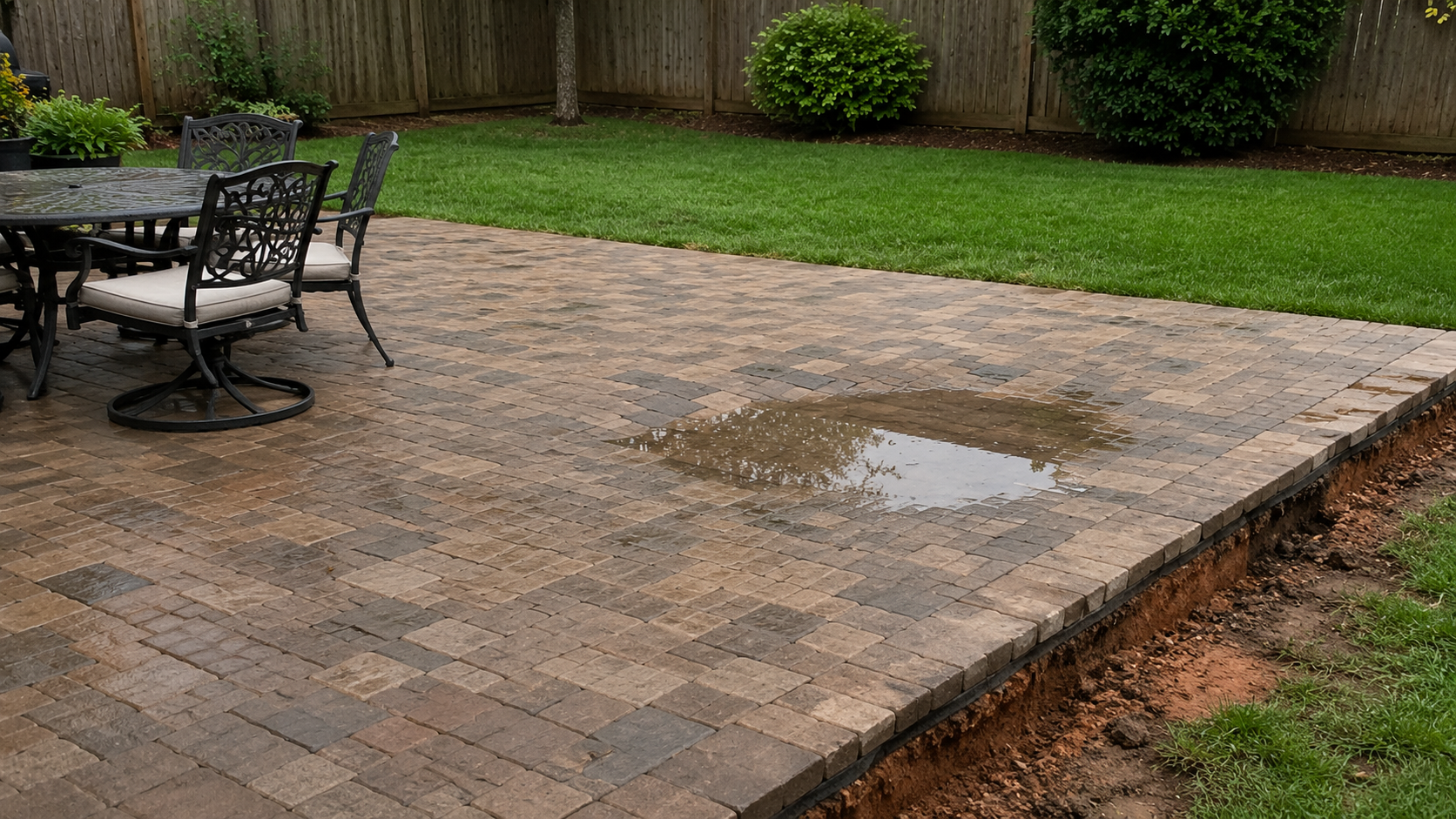
Pavers sink because of what sits underneath them, almost never because of the pavers themselves. A base that was too thin, poorly compacted, or undermined by water will settle, and the pavers follow it down. A small amount of settling is normal on any paver surface, but dips deep enough to hold water point to a base problem worth fixing.
Why do pavers sink? The answer sits four to six inches below what you can see. Pavers ride on a compacted stone base, and when that base thins out, loosens, or washes away, the surface drops with it. The pavers themselves almost never fail.
That distinction matters, because it changes what a repair costs and how long it lasts. Resetting pavers without fixing the base means the same dip returns within a year or two.
Why Do Pavers Sink in the First Place?
Four failures cause nearly every sunken paver, and three of them happen during installation.
The base was too thin. The Concrete Masonry and Hardscapes Association, the industry body that sets installation standards, specifies a minimum compacted base of 4 inches for patios and 6 inches for residential driveways over well drained soils. Crews that skip depth to save time and material build in a failure.
The crew skipped compaction. CMHA calls for compaction to at least 98 percent of standard Proctor density. Loose aggregate keeps settling under foot traffic and furniture for years after the job ends.
Water got underneath. Runoff from a downspout, a poorly graded yard, or a missing drain washes fine material out of the base and leaves voids. The pavers sink into those voids.
The edges gave way. Edge restraints hold the outer pavers from spreading outward. When they fail, joints widen, sand escapes, and the whole field loosens.
Notice what is missing from that list. Age, foot traffic, and the quality of the pavers barely register. A properly built paver patio stays flat for decades.
Is Some Settling Normal?
Yes, and good installers plan for it. CMHA guidance calls for setting the finished pavers 1/8 to 1/4 inch above final grade specifically to allow for minor settling, and notes that a small amount of movement happens on all flexible pavements.
So a surface that dropped a fraction of an inch in its first year sits within normal range. A dip that holds a puddle after rain does not. Standing water tells you the base has failed locally, and it accelerates the damage by washing out more material every time it rains.
Use water as your test. If your patio sheds rain the way it always did, you probably have normal settling. If it collects, you have a base problem.
How Deep Should a Paver Base Be?
A patio needs at least 4 inches of compacted base and a residential driveway needs at least 6 inches, measured after compaction rather than before. Those numbers apply to well drained soils.
Oklahoma soils are not well drained. CMHA ties base thickness to soil type, subgrade drainage, and moisture, and notes that regions with expansive soils often use greater thicknesses. Tulsa area clay is an expansive soil.
Two other layers matter as much as depth:
- Bedding sand at a nominal 1 inch, uncompacted. CMHA specifically warns against using masonry sand, limestone screenings, or stone dust for bedding. They compact unevenly and block drainage.
- Edge restraints with at least 1 inch of vertical contact against the paver. Anything less lets the field creep outward.
When you compare quotes for a new patio, ask for base depth in writing. A contractor who will not commit to a number is telling you something.
Why Do Pavers Sink Faster in Oklahoma Clay?
Oklahoma clay swells when it gets wet and shrinks when it dries, and that cycle moves the ground under a patio far more than foot traffic ever will. The base rides on top of soil that changes volume with the weather.
Tulsa area soils drain slowly, so water lingers against the subgrade long after a storm passes. CMHA notes that geotextile may be used over clay and moist silty subgrade soils to keep soil from migrating up into the aggregate, and recommends drain pipes in clay soils that carry vehicle traffic. Installers who skip both steps on Oklahoma clay are building for a climate we do not have.
Drainage around the patio matters just as much as the layers beneath it. If water pools in your yard before it reaches the patio, fixing the standing water in your backyard protects the paver base at the same time.
How Do You Fix a Sunken Paver Patio?
You lift the affected pavers, repair and recompact the base underneath, then reset them. Skipping the middle step is why so many paver repairs fail twice.
The work runs in this order:
- Lift the pavers in the sunken area plus a margin around it
- Clear out loose sand, debris, and any soft or muddy soil
- Add aggregate in layers and compact each layer before adding the next
- Screed a fresh 1 inch bedding sand layer to grade
- Reset the pavers, then sweep and compact joint sand into place
Scope depends on what failed. A single low paver over a small void is a quick fix. A whole section that dropped because the base was built too thin means rebuilding that section properly, and the cost climbs toward what a new installation would run. Our guide to paver patio cost in Tulsa gives you the numbers to compare against.
One shortcut deserves a warning. Adding sand under a sunken paver without touching the base hides the dip for a season. The void underneath keeps growing and the paver drops again.
Can Sunken Pavers Be Reused?
Almost always, yes. Concrete pavers are dense units built to a compressive strength standard of 8,000 psi, and sinking does not damage them. They went down with the base, so they come back up intact.
Plan on replacing a few units if a section cracked under vehicle weight or a corner chipped during removal. Keeping leftover pavers from the original installation makes those swaps invisible. Without leftovers, a contractor can usually source a close match, though color varies slightly between production runs and weathering.
The material you will need to replace is the base aggregate and the sand. Those are the parts that failed.
How Do You Keep Pavers From Sinking?
Build the base correctly, then keep water moving away from it. Everything else is maintenance.
- Direct downspouts away from paved areas. Concentrated runoff undermines a base faster than anything else in a yard.
- Keep the slope. A finished patio should shed water at a minimum of 1.5 percent grade per CMHA guidance.
- Refill joint sand as it disappears. Joint sand locks the pavers into each other. Empty joints let the field shift.
- Check the edges each spring. Widening gaps along the perimeter mean the edge restraint is losing its grip.
- Match the surface to the load. A patio base will not hold up under a parked vehicle.
Arrow Outdoor Living has installed hardscape across the Tulsa metro since 2021 with in house crews rather than subcontractors. You can see the full range of work on our Tulsa paver installation page.
Get Your Patio Looked At
A sunken paver rarely means you need a new patio. It means something underneath needs attention, and catching it early keeps the repair small.
We serve Tulsa, Broken Arrow, Bixby, Jenks, Owasso, and the surrounding communities. Our crews will walk your patio, find what actually failed, and tell you straight whether it needs a spot repair or a rebuilt section.